
Samsung VXT Alternative: The Enterprise Solution
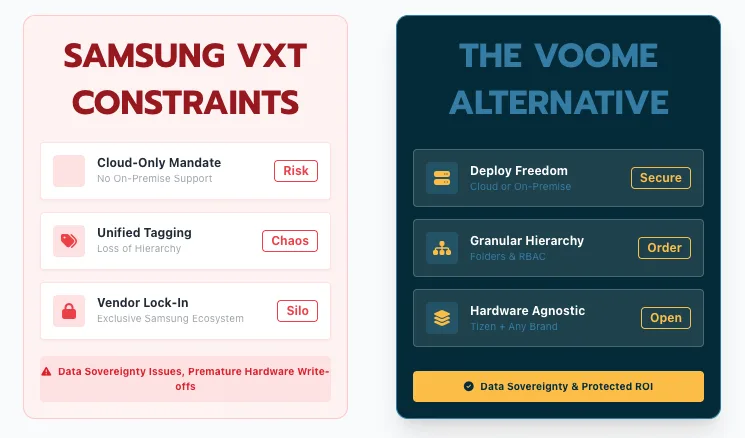
Beyond MagicInfo: Why Enterprise IT Leaders Need an Alternative to Samsung VXT | Voome & Enterprise IT & Governance June 2026 Beyond MagicInfo: Why Enterprise IT Leaders Need an Alternative to Samsung VXT. Samsung’s MagicInfo has reached its End of Life. While VXT is heavily promoted as the successor, its rigid cloud-only model and loss of granular hierarchy create critical bottlenecks for corporate governance. Here is how Voome restores control. VT Voome Team Digital Signage Governance Article8 Min Read Key Takeaways (Executive Summary) ■The Cloud-Only Mandate: VXT is hosted strictly on vendor infrastructure, violating data sovereignty policies for banks, hospitals, and government entities requiring On-Premise control. ■Management Chaos via Unified Tagging: VXT replaces traditional hierarchical folders with tags, creating administrative risk in massive enterprise display networks. ■The Voome Solution: Native integration with Samsung Tizen displays, offering a choice of Cloud or On-Premise deployment, ISO 27001 security, and full MDM diagnostics. The Landscape: Why MagicInfo’s Retirement is Sparking Concern For years, Samsung’s MagicInfo has been a cornerstone for organizations managing large-scale digital signage networks. However, with MagicInfo reaching its End of Life, IT managers, CIOs, and system integrators are forced to navigate a mandatory transition. Samsung’s designated successor, VXT, is heavily promoted as the next step. Yet, for enterprise-grade environments with strict governance, compliance, and multi-layered operational needs, VXT introduces critical bottlenecks. Transitioning your digital signage infrastructure is inevitable, but the destination doesn’t have to be dictated by a single vendor’s roadmap. Many enterprise IT teams evaluating VXT find that it fundamentally clashes with established corporate governance models. Migration Crossroads: VXT vs. Voome Evaluating rigid vendor lockdown against flexible enterprise architecture Samsung VXT Constraints Cloud-Only MandateNo On-Premise Support Risk Unified TaggingLoss of Hierarchy Chaos Vendor Lock-InExclusive Samsung Ecosystem Silo Data Sovereignty Issues, Premature Hardware Write-offs The Voome Alternative Deploy FreedomCloud or On-Premise Secure Granular HierarchyFolders & RBAC Order Hardware AgnosticTizen + Any Brand Open Data Sovereignty & Protected ROI Taking Back Control with Voome and Samsung Tizen You do not need to abandon your Samsung hardware investment to meet your corporate governance standards. Voome integrates natively with Samsung SoC (Tizen) displays, treating them as smart endpoints within a managed, flexible ecosystem. Rather than forcing a one-size-fits-all cloud approach, Voome restores architectural control through flexible deployment options (ISO 27001-certified Cloud or full On-Premise installation), advanced MDM diagnostics (low-level telemetry, CPU monitoring, OTA firmware updates), and native data connectors (Microsoft 365, Qlik, PowerBI). Future-Proofing ROI: The Power of Being Hardware Agnostic One of the most significant hidden costs of transitioning to a proprietary platform like VXT is the reinforcement of vendor lock-in. When your software is irrevocably tied to a single manufacturer, your future procurement strategies are compromised. Voome breaks this cycle by being fundamentally hardware agnostic. While Voome natively manages Samsung Tizen displays with deep integration, it is not restricted to them. This means that if your procurement strategy shifts tomorrow—for instance, if you decide to purchase Hisense displays for a new branch, or integrate LG webOS, Windows, or Android players—you do not need to discard your software or train your staff on a new CMS. Voome provides a unified “Single Pane of Glass” to manage diverse hardware fleets. This agnosticism guarantees the longevity of your software investment and maximizes your Return on Investment (ROI) by giving you the freedom to choose the best hardware for your budget, both today and in the future. An Opportunity to Evolve The retirement of Samsung MagicInfo should not be viewed merely as a technical hurdle; it is a strategic opportunity. By evaluating platforms that respect your infrastructure choices, you can protect hardware investments, comply with strict security mandates, and eliminate recurring cloud fees and vendor lock-in. ? Frequently Asked Questions (FAQ) Why is Samsung MagicInfo retirement causing concern for IT leaders? MagicInfo’s retirement forces a transition to Samsung VXT. However, VXT’s strict cloud-only mandate, replacement of hierarchical structures with unified tagging, and vendor lock-in clash with enterprise governance, compliance, and data sovereignty requirements. Can Voome deploy on-premise for Samsung Tizen displays? Yes. Unlike VXT’s cloud-only model, Voome offers flexible deployment: organizations can choose between an ISO 27001-certified Cloud infrastructure or a full On-Premise installation hosted on internal corporate servers, ensuring absolute data sovereignty. How does Voome manage Samsung Tizen screens beyond basic signage? Voome acts as a true Mobile Device Management (MDM) system for Tizen displays, offering low-level telemetry (CPU temperatures, storage capacity), remote hardware reboots, clear-cache capabilities, mass OTA firmware updates, and log extraction.
Digital Signage and Room Booking: Stop Software Bloat
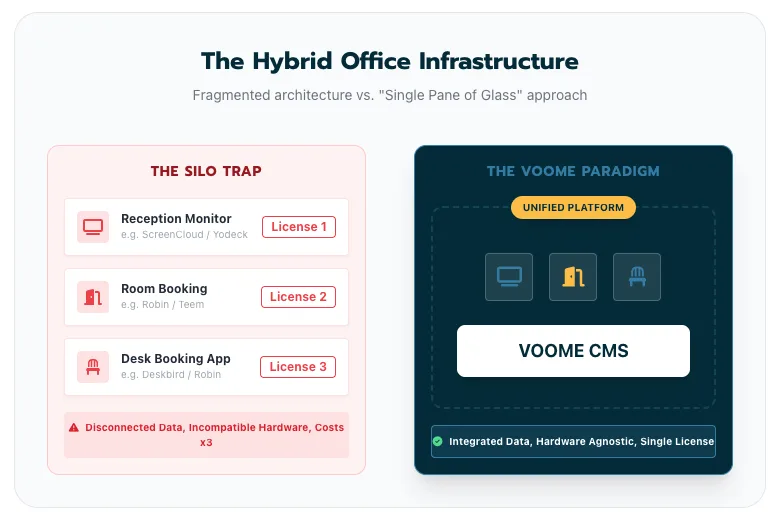
Digital Signage and Room Booking: Stop Software Bloat | Voome Hybrid Workplace September 15, 2026 Digital Signage and Room Booking: How to eliminate Software Bloat. Companies pay for 3 different licenses to manage an employee entering the office. How Voome’s architectural convergence destroys the IT nightmare of siloed software for hybrid work. VT Voome Team IT Governance Article7 Min Read Key Takeaways (Executive Summary) ■The problem of SaaS Bloat: On average, post-pandemic companies use up to 130 SaaS applications. In hybrid offices, this translates into using disconnected software to manage physical presence and communication. ■The failure of the Silo approach: Cloud platforms like ScreenCloud or Yodeck handle images well but force IT to purchase third-party software (like Robin or Condeco) for Room Booking, doubling costs. ■The Voome Paradigm: Native convergence. Voome acts as an “Operations Hub”, managing both visual communication and interactive booking of meeting rooms and desks (Hot Desking) on the same architecture. The Hidden Cost of the Hybrid Office The return to the office is no longer fixed; it’s fluid. This fluidity has generated organizational chaos for IT and Facility Management Departments. According to recent studies, enterprise companies spend millions on redundant software licenses, a phenomenon known as “SaaS Bloat”. The problem is exacerbated by legacy subscription models offered by competitors, often based on a “Per-User” basis: you end up paying for licenses for employees who are remote working. Voome’s “Resource-Based” architecture, on the other hand, optimizes costs by charging only for actual infrastructure, ensuring OPEX predictability. Let’s analyze the operational journey of an employee entering the headquarters on a Tuesday morning. They need to view company policies or communications on the lobby monitors, book a free desk to work at, and reserve a meeting room for a presentation in the afternoon. Thanks to Voome’s “Bundle Engine” (Parent-Child logic), booking can occur via an Interactive Map, automatically linking accessory resources (e.g., parking, catering, or IT hardware) to the main event and eliminating scattered emails to Facility Management. In a fragmented IT infrastructure (the model pushed by most competitors on the market), these three simple actions require three different software subscriptions, often incompatible with each other. The Hybrid Office Infrastructure Fragmented architecture vs. “Single Pane of Glass” approach The Silo Trap Reception Monitore.g. ScreenCloud / Yodeck License 1 Room Bookinge.g. Robin / Teem License 2 Desk Booking Appe.g. Deskbird / Robin License 3 Disconnected Data, Incompatible Hardware, Costs x3 The Voome Paradigm UNIFIED PLATFORM VOOME CMS Integrated Data, Hardware Agnostic, Single License Beyond “Welcome”: The Screen Becomes an Operational Tool The fundamental difference between a pure broadcasting platform (which simply plays slides or corporate videos in a loop) and an Operations Hub like Voome is the ability to let the user interact with the surrounding physical environment. With the dedicated Room Booking module, the same CMS that the Internal Comms department uses to update HR policies is utilized by Facility Management to handle space allocation. Upon entering, an employee can interact with a touch kiosk, view wayfinding (the 3D map) to see where their booked desk is located for the day (Hot Desking). Simultaneously, another employee can extend their meeting directly from the small touch display outside the meeting room door (thanks to native integration with Microsoft Exchange/M365 or Google Workspace). Crucially, Voome’s room signs offer a “Customizable Total Look,” allowing you to modify logos and backgrounds to align with the brand, while “Integrated Hardware Control” lets IT restart or update displays remotely from the same dashboard. The Enterprise Verdict for CIOs Purchasing one software just to show images at reception and a different software to allow employees to book rooms is no longer justifiable in today’s IT budgets. The convergence offered by Voome eliminates “Software Bloat,” consolidating the entire visual infrastructure and physical office management under a single ISO 27001 certified roof. Furthermore, thanks to Workspace Insights, features like avoiding “Ghost Meetings” (rooms booked but never physically occupied) automatically free up unused resources, guaranteeing tangible space optimization. ? Frequently Asked Questions (FAQ) What is ‘SaaS Bloat’ and how does it impact the hybrid office? SaaS Bloat is the excessive accumulation of redundant software licenses in a company. In the Hybrid Workplace, this translates into paying for and managing different (and often disconnected) platforms for digital signage, meeting room booking, and desk management, multiplying IT costs. How does the integration between Signage and Room Booking work in Voome? Voome acts as a unified “Operations Hub”. On the same architecture, it allows the Internal Comms department to update schedules on monitors, and Facility Management to manage space bookings, leveraging native integration with Microsoft 365 or Google Workspace. What is the advantage of Voome’s Per-Resource subscription model? Unlike legacy ‘Per-User’ models, which force you to pay for licenses even for employees working remotely, Voome’s ‘Per-Resource’ model optimizes costs by charging only for the actual infrastructure (mapped rooms or desks), ensuring immediate ROI.
Create Interactive Digital Signage Without Code
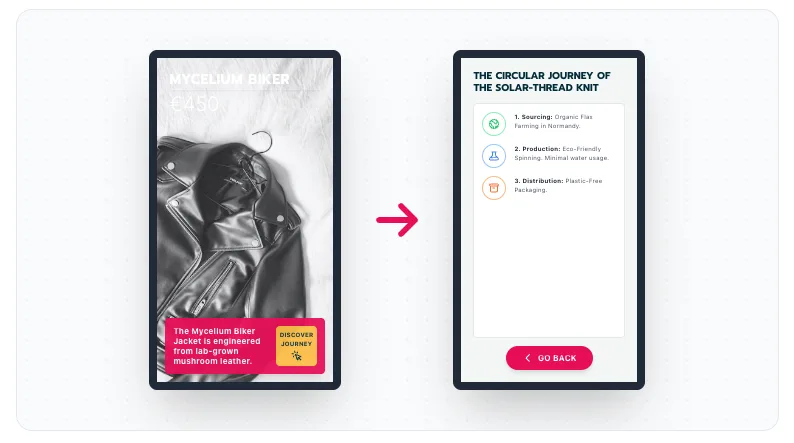
The Illusion of Passive Digital Signage: Out-of-the-Box Touch Interactivity | Voome Engagement & Interactivity August 31, 2026 The Illusion of Passive Digital Signage: Out-of-the-Box Touch Interactivity. Competitors sell you endless media carousels or force you to hire external agencies to develop custom HTML5 apps. Discover how Voome’s native editor democratizes the creation of interactive kiosks and dashboards without writing a single line of code. VT Voome Team Engineering & Product Article 9 Min Read In this article 1. The hidden cost of HTML5 2. Retail: Discover More 3. Corporate: Bulletin Board 4. Control: Remote Launcher The Enterprise Verdict FAQ Key Takeaways (Executive Summary) ■ The missed opportunity: We live in the smartphone era. A purely passive digital signage network generates low conversion rates in retail and poor attention retention in corporate environments. ■ The hidden cost: Many enterprise platforms support interactivity but force you to hire external agencies to develop custom code apps (HTML5 or React), drastically inflating costs and Time-to-Market. ■ The Voome Paradigm: The interactive module integrated into our native CMS allows you to draw touch buttons, navigable menus, and action logic right “Out-of-the-Box.” No coding required, ensuring total autonomy for your Marketing team. 1. The Touch Illusion and the Cost of HTML5 The digital signage market is often divided into two extremes. On one side, there are entry-level cloud platforms designed solely to display simple image carousels, completely lacking support for touch interactions. On the other side are heavy Enterprise suites. These support interactivity but at a very high price: the necessity for custom development. This means that to add a simple “Discover More” button to a promotional video, a company must contact an external agency, have HTML5 code written, test it, and then painstakingly upload it to the player. Voome’s Interactive Module removes this hurdle, democratizing the creation of engaging experiences directly from the drag-and-drop editor. Three Real Use Cases: From Passive to Interactive 2. Retail: The “Discover More” Experience Imagine a kiosk in a flagship store. The screen normally displays an emotional product video (e.g., an eco-sustainable jacket). Instead of letting interest fade, the Voome editor allows you to overlay a touch button. By tapping it, the customer interrupts the video and opens a detailed page about the production supply chain, exploring the product autonomously. MYCELIUM BIKER €450 The Mycelium Biker Jacket is engineered from lab-grown mushroom leather. DISCOVERJOURNEY THE CIRCULAR JOURNEY OF THE SOLAR-THREAD KNIT 1. Sourcing: Organic Flax Farming in Normandy. 2. Production: Eco-Friendly Spinning. Minimal water usage. 3. Distribution: Plastic-Free Packaging. GO BACK Read the “Discover More” technical documentation on the Wiki 3. Corporate: The Bulletin Board In corporate offices or break areas, a screen looping HR policies is ignored after the first day. With the Bulletin Board, you transform the screen into an interactive, tab-navigable corporate hub. Employees can tap “HR News” to read announcements, or switch to “KPI Score Card” for live production data. Voome HR News KPI Score Card Working Shift Discover DISCOVER VOOME DIGITAL SIGNAGE PLATFORM Why Voome Digital Signage Platform What sets us apart from the others: Process automation. Reliability Safety Integrations Image Placeholder Your News | 04 Aug 12:48 Platform Update: The new Native API integration with Google Workspace is now available for all enterprise clients… Learn how to configure a Bulletin Board on the Wiki 4. Control: The Remote Launcher Ideal for showrooms, prestigious reception areas, or corporate control centers. A tablet or touch screen acts as a true “smart remote.” The user browses through a library of projects (videos, floor plans, presentations) and, by tapping an icon, instantly launches the content onto a distant Video Wall or a specific monitor. MONITORS VIDEO WALL TOUCH MONITOR Type: spinetix Status: Ready ON DEMAND ALL CASE STUDIES Demo Directions Case Study – Logistics Case Study – Cruise Case Study – Agenda Consult the Remote Launcher guide on the Wiki The Enterprise Verdict In conclusion, Voome’s interactive editor is not just a feature, but a genuine paradigm shift. It transforms digital signage from a passive cost center into a measurable engagement tool, empowering your marketing or IT department to create advanced experiences at zero external cost and with total autonomy—without writing a single line of HTML code. ? Frequently Asked Questions (FAQ) Do I need an external agency to create interactive touch screens? Absolutely not. With Voome’s native CMS editor, you can design touch areas, create navigable menus, and set up interaction logic “out-of-the-box” without writing HTML5 code or relying on external agencies. The interface is designed to be used visually, much like presentation software. What can you build with Voome’s interactive module? You can cover various sectors: create “Discover More” applications to explore products in retail, build tab-navigable “Bulletin Boards” for internal corporate communication (HR data, KPIs), or set up “Remote Launchers” to command video walls and complex installations in real time directly from a tablet’s touch screen.
The illusion of usability: why forcing staff to use a CMS kills adoption
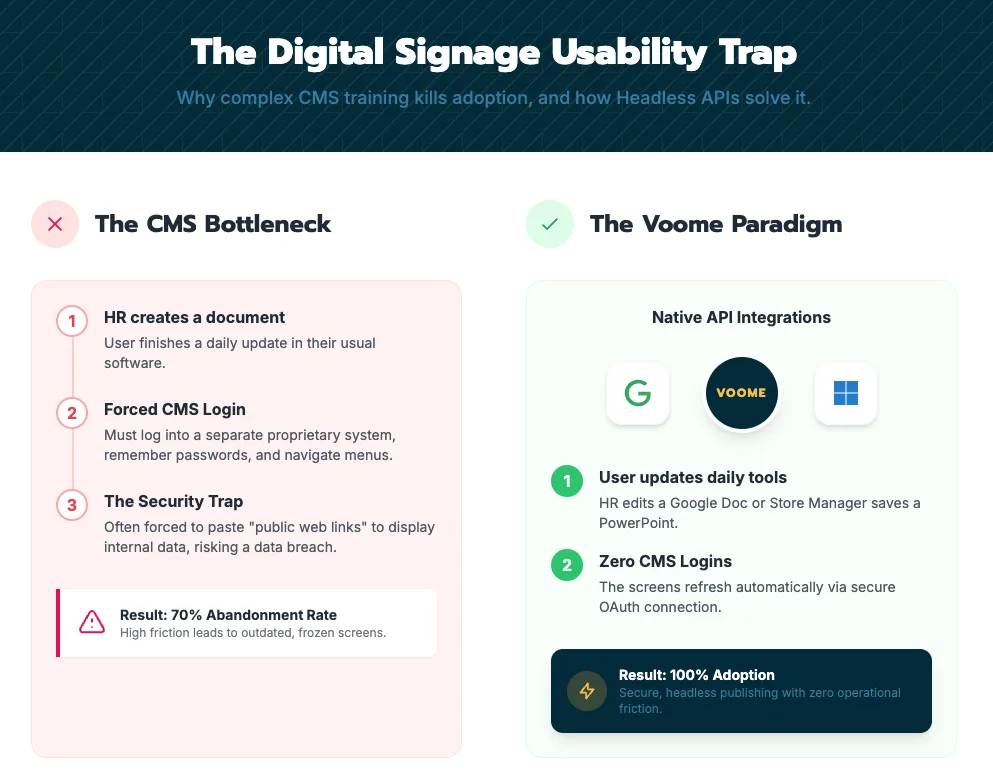
The illusion of usability: why forcing staff to use a CMS kills adoption | Voome User Experience & Security August 24, 2026 The illusion of usability: why forcing staff to use a CMS kills adoption. Competitors boast about their “intuitive dashboards.” But the truth is, non-technical staff don’t want another software to learn. How Voome’s Native APIs turn Google Workspace and Microsoft 365 into your true publishing engine. VT Voome Team Engineering & Product Article 10 Min Read In this article 1. The Abandonment Rate 2. The Public Link Trap 3. Native API Integrations Use Case: Microsoft 365 Use Case: Google Workspace The Enterprise Verdict FAQ Key Takeaways (Executive Summary) ■ The adoption bottleneck: Alarmingly, 70% of digital signage networks suffer from outdated content. This happens because non-technical staff (HR, Store Managers) simply do not have the time or skills to log into, navigate, and manage a proprietary CMS. ■ The security risk: Competitors frequently attempt to solve this by allowing users to paste “public web links” to display Google Docs or Power BI dashboards. However, in a corporate environment, exposing internal data via public iframes is a massive security breach. ■ The Voome Paradigm: We advocate for headless publishing. Specifically, we connect Voome directly to your Google Workspace and Microsoft 365 via secure, native APIs. Consequently, staff update their everyday Docs, Sheets, or PowerPoint files, and the screens update automatically. Zero CMS training required. 1. The CMS Abandonment Rate Look at any promotional video for an entry-level digital signage platform (like Yodeck or ScreenCloud), or even a heavy enterprise workplace system (like Appspace). Inevitably, they spend minutes showcasing their “drag-and-drop” CMS interface. Sure, it looks great in a demo. Nevertheless, here is the harsh reality of corporate and retail operations: The person managing the screen content is rarely a graphic designer or a dedicated IT administrator. Instead, it is the HR Manager trying to post a company announcement. Furthermore, it is the Store Manager trying to update daily opening hours, or the Factory Floor Supervisor displaying production metrics. Consequently, forcing these actors to learn a new proprietary CMS, remember login credentials, understand aspect ratios, and navigate playlist scheduling creates massive friction. The end result? Screen abandonment. Content quickly becomes stale, and ultimately, an expensive digital touchpoint turns into a glorified digital photo frame showing last month’s news. 2. The “Public Web Link” Trap: A Security Nightmare Naturally, competitors are aware of this usability issue. Therefore, their “workaround” is often to tell customers: “Just build your dashboard in Excel or Google Sheets, generate a public sharing link, and paste the URL into our CMS!” ❌ The IT Compliance Disaster In a corporate, financial, or healthcare environment, data security is paramount. Generating an unauthenticated “Anyone with the link can view” URL for an internal HR memo, a financial Qlik dashboard, or a daily sales spreadsheet is a massive violation of security protocols (like ISO 27001). Furthermore, public links often fail to auto-refresh correctly on edge devices, thereby leading to frozen screens. 3. The Voome Approach: Headless Signage via Native APIs Ultimately, if the goal is to optimize internal processes, technology must adapt to the user’s existing workflow, not the other way around. This is why Voome completely removes the CMS bottleneck for end-users through Native API Integrations. Initially, the Marketing or IT team sets up the screen layout once inside Voome. Subsequently, they connect the specific layers of that screen directly to the secure company servers. As a result, the end-user never logs into Voome again. Microsoft 365 Integration Seamlessly integrate Voome with your Microsoft ecosystem. This solution is perfect for corporate environments relying heavily on SharePoint and OneDrive. ✓ PowerPoint Sync: Simply update a PPTX file on OneDrive, and the screens refresh automatically. ✓ Secure Authentication: Moreover, OAuth 2.0 ensures only authorized enterprise accounts can connect. Explore M365 Integration Google Workspace Transform Docs, Sheets, and Slides into dynamic digital signage assets effortlessly. Consequently, no manual exports or repetitive uploads are required. ✓ Live Google Sheets: Display real-time KPIs and production dashboards securely. ✓ Drive Sync: In addition, manage menus or promotions simply by replacing an image in a shared Google Drive folder. Explore Google Integration This methodology is what we call “Headless Publishing.” For instance, the HR department updates a Google Slide on their desktop. Once they press save, within seconds, the displays in the breakroom update automatically. Similarly, the Store Manager replaces a promotion image inside a designated OneDrive folder, and the screens in the window immediately reflect the change. In short: Zero training sessions. Zero CMS logins. Zero friction. Ultimately leading to 100% Adoption. The Enterprise Verdict In conclusion, a CMS that requires your entire workforce to become signage experts is fundamentally a failed CMS. By relying on risky public web links, competitors inadvertently compromise your network’s security and stability. Conversely, Voome’s Native API architecture respects your established corporate workflows, seamlessly turning the tools you already use (Google Workspace and Microsoft 365) into secure, automated publishing engines. ? Frequently Asked Questions (FAQ) What is the main problem with standard Digital Signage CMS usability? The main problem is the learning curve. Forcing non-technical staff (HR managers, store clerks, or factory supervisors) to learn a proprietary CMS just to update a daily schedule creates operational friction. This inevitably leads to outdated content and abandoned screens. How does native API integration differ from using public web links? Competitors often tell users to paste “public web links” to display external documents or dashboards, which poses a massive security risk (data breach) and requires manual refreshes. Voome uses Native APIs (OAuth) for Google Workspace and Microsoft 365, ensuring corporate-level security, restricted access, and seamless, automatic real-time updates.
The illusion of scalability: why “Playlist” management collapses your network
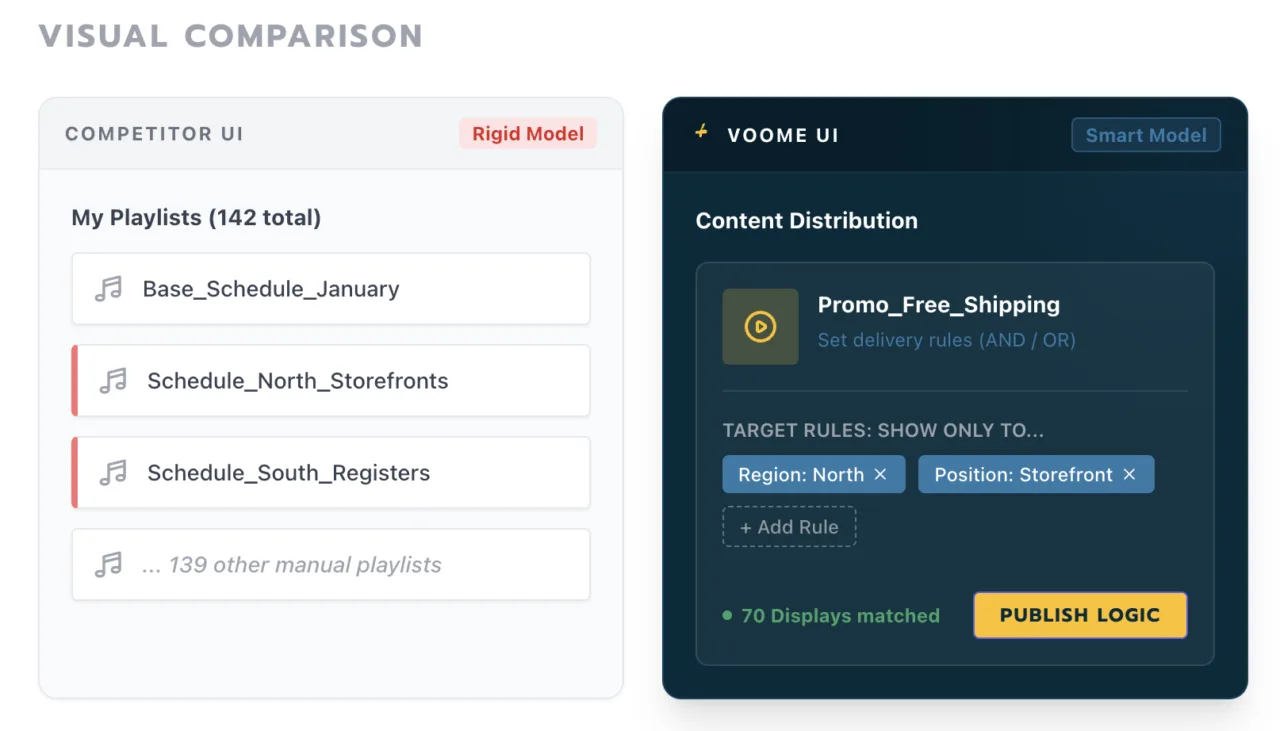
The illusion of scalability: why “Playlist” management collapses your network Scalability & Operations August 4, 2026 The illusion of scalability: why “Playlist” management collapses your network. Competitors’ tutorials show how easy it is to publish on 5 screens. But when stores reach 500 and promotions become regionalized, the traditional system crumbles. The strategic shift towards Smart Tags. VT Voome Team Engineering & Product Article 12 Min Read In this article The Drag & Drop Myth 1. The 100 Playlist Nightmare 2. The Solution: Smart Tags 3. Voome vs Competitor (UI) 4. The “Black Screen” Risk 5. Multi-User Governance The Enterprise Verdict FAQ Key Takeaways (Executive Summary) ■ The industry limitation: Traditional platforms force users to create manual playlists and assign them screen by screen. This 1-to-1 model generates human error and paralyzes update times on large-scale networks. ■ Operational paralysis: Managing regional differences or store-specific promotions forces operators, in standard systems, to duplicate and maintain dozens (or hundreds) of playlists that are 90% identical. ■ The Voome Paradigm: We abandon the concept of “Playlist assigned to Player”. Voome uses Geographical Clusters and Smart Tags: content is distributed automatically based on logical rules (e.g., “Show this video only to monitors tagged ‘North’ and ‘Storefront’”). If we look at the video tutorials of entry-level platforms like Yodeck, ScreenCloud, or even closed ecosystems like Samsung VXT, the publishing process is always sold with the same apparently magical and linear *workflow*. 1. You upload the video file. 2. You place it in a Playlist. 3. You create a schedule and 4. You manually assign the Playlist to the screen in the store. It is a model based on direct “Push” (from file to screen). And it works great, but only if you have 5 screens to manage. 1. The 100 Playlist Nightmare: A real case Let’s do a crash test in the reality of an *Enterprise* marketing department. Imagine managing a retail network with 500 monitors scattered nationwide. The base schedule is identical for everyone, but the Commercial Direction launches a “Free Shipping” promotion valid only for stores in the North and only for Storefront monitors (excluding those at the cash registers). ❌ How you are forced to do it with Competitors: Because traditional platforms think in “rigid containers”, the operator will have to: Duplicate the general playlist. Remove the old video. Insert the new promotion. Rename the playlist (e.g., “Playlist_North_Storefronts”). Navigate the device tree, manually search for the 70 screens that match those criteria, and assign the new playlist to each one. Result: Dozens of redundant playlists to update individually at the next campaign change. A very high human error rate. 2. The Paradigm Shift: Geographical Clusters and Smart Tags To scale without collapsing operations, the logic must be inverted. It shouldn’t be you chasing the screen. The screen must be “smart” enough to understand what to show. In Voome, devices are Tagged and categorized into logical and geographical Clusters during installation (e.g., Region: North, City: London, Type: Storefront). When Marketing uploads new content, they don’t assign it to a static playlist. They assign Distribution Rules. Visual Comparison Competitor UI Rigid Model My Playlists (142 total) Base_Schedule_January Schedule_North_Storefronts Schedule_South_Registers … 139 other manual playlists Voome UI Smart Model Content Distribution Promo_Free_Shipping Set delivery rules (AND / OR) Target Rules: Show only to… Region: North Position: Storefront + Add Rule 70 Displays matched Publish Logic As seen from the interface, in Voome, management is centralized around the intent of the campaign. We tell the system: “Send this video to the North, but only to storefronts”. The CMS processes the rule in real-time, scans the device database, and updates local schedules in milliseconds. Zero duplications. Zero manual playlists. Maximum scalability. 3. The “Black Screen” Risk: Scheduling under the Hood The playlist trap hides another insidious technical problem: gaps between content. Traditional schedulers often rely on chronological logic that forces the hardware player to constantly load and unload files. What happens when a file is heavy or the network is unstable? Micro-interruptions. Digital Signage Schedule Comparison Unlike traditional scheduling prone to black screens and gaps, the Voome Engine guarantees zero-downtime by processing a continuous seamless loop. VS TRADITIONAL SCHEDULE(Competitors) Time A A B Gap RiskBlack Screen C Linear Loading Constraints SCHEDULE AUTOMATION Project A Project B Project C VoomeENGINE Continuous Seamless Loop A B Priority C Automated Reliability Zero-Downtime 4. Multi-User Zone Governance: Beyond Playlists Scalability is not just about distributing content; it’s about who manages it. In an enterprise environment, a single screen often serves multiple departments. The Marketing team needs to push promotional videos, the HR department wants to overlay internal communication, and the Production manager needs a ticker with live KPIs. Traditional playlists force all these actors to fight over a single schedule timeline, creating bottlenecks. Voome resolves this with a Structured CMS Per Layer. Similar to Photoshop, the screen is divided into independent infinite layers (e.g., Background Video, Overlay Ticker, Priority Widget). Each department has exclusive access only to their assigned layer. One Screen. Multiple Actors. Zero Conflicts. The Enterprise Verdict Playlist management is a logistical prison disguised as simplicity. When competitors show you their “drag & drop”, ask them what happens when you need to surgically update 50 stores in 10 different regions while preventing black screens. Voome’s logical architecture based on Smart Tags and a Layered Engine reduces operational time by 80% and eliminates the risk of publishing the wrong promotion on the wrong screen. ? Frequently Asked Questions (FAQ) What is the main limitation of Playlist management in Digital Signage? Playlist management requires a rigid 1-to-1 assignment. If you need to differentiate a campaign across 500 screens based on specific local exceptions, you will be forced to duplicate and maintain dozens of different playlists for each scenario, multiplying operational times. How does content distribution via Smart Tags work in Voome? In Voome, you don’t assign content to a rigid screen, but you assign logical rules. Players are labeled during setup (e.g., Tag: “London”, Tag: “Checkout_Area”). Uploading a new
The illusion of control: why basic Device Management kills your scalability.
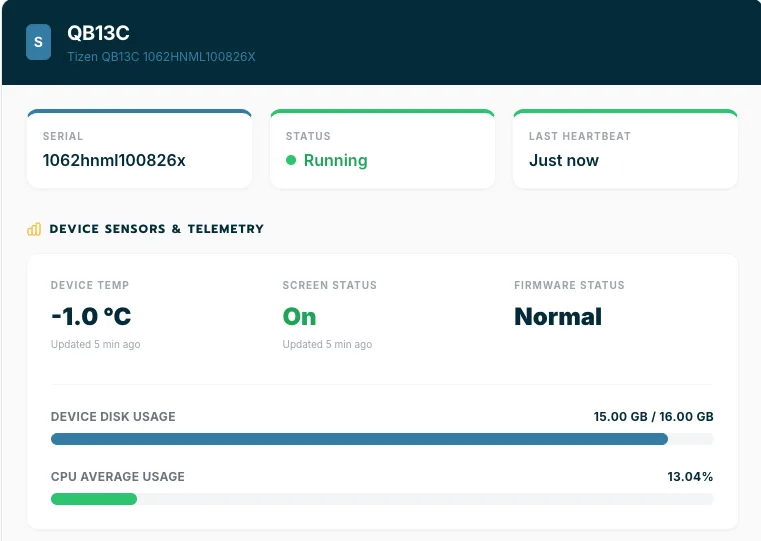
The Illusion of Control in Digital Signage: REAL Device Management | Voome Product Strategy July 20, 2026 The illusion of control: why basic Device Management kills your scalability. Competitors’ promotional videos show how easy it is to upload an image. But what happens when 50 screens go offline simultaneously? The difference between a basic CMS and a true All-in-One platform. VT Voome Team Engineering & Product Article 8 Min Read In this article The Deployment Problem 1. Entry-Level: DIY 2. Enterprise: Over-Engineering 3. Vendor Lock-in 4. Telemetry Deep Dive The Enterprise Verdict Frequently Asked Questions Executive Summary ■ The problem: Many cloud platforms offer fast onboarding but hide structural limits in remote troubleshooting, requiring continuous and expensive on-site IT interventions. ■ Vendor Lock-in: Hardware-bound solutions (e.g., Samsung VXT) tie the company to a single brand, preventing scalability across a heterogeneous device fleet. ■ The Voome solution: A single hardware-agnostic interface with advanced telemetry (CPU, Disk, Temperature) and direct control without third-party MDMs. Content deployment is just the beginning. When evaluating a digital signage platform for an enterprise or complex retail network, competitors’ marketing materials always show the same scene: a smooth drag-and-drop and a screen turning on. But in the real world of operations, the true challenge – and the true hidden cost center – lies in daily maintenance and downtime resolution. Having a “black screen” in a store means losing revenue and damaging the brand image. Let’s see why the most popular solutions fail to guarantee business continuity. 1. Entry-Level Cloud: The limits of “Do-It-Yourself” Troubleshooting Entry-level cloud platforms promise lightning-fast onboarding. However, when analyzing their technical documentation, a disastrous workflow for scalability emerges. Faced with a network disconnection or player error, resolution is almost always manual and tied to physical hardware checks. For a Marketing Department managing hundreds of touchpoints, this means having to open an IT ticket for every minor anomaly or, worse, sending personnel physically on-site to unplug and replug cables. Remote monitoring is often limited to a basic green/red indicator, leaving management completely blind to the root causes of the problem. 2. IT-Heavy Enterprise: The weight of Over-Engineering At the opposite end of the spectrum, we find complex workplace experience software. Massive platforms that require a huge effort during setup and integration. The paradox? Despite their complexity, they often lack native, granular control over the hardware. To achieve real remote management, companies are forced to purchase and integrate expensive third-party MDM (Mobile Device Management) software. This creates a siloed ecosystem: marketing uses the CMS to update layouts, while IT must access a separate MDM portal to reboot screens. A fragmentation that destroys operational efficiency and drastically slows down time-to-market. 3. The “Gilded Cage” of Vendor Lock-in vs. The Hardware-Agnostic Approach Some market giants offer solid management systems (e.g., MagicINFO or the newer VXT), but they are designed to operate exclusively within their proprietary hardware ecosystem. If your Remote Device Management only works on a specific SoC, the technology will end up dictating your purchasing strategy. At Voome, we believe the infrastructure should adapt to the brand, not the other way around. That’s why we designed a dashboard capable of unifying the control of completely different machines. Voome Unified Network Dashboard Device Info Network Tools HMP 400 – Touch demo RUNNING SpinetiX HMP 400 IP: 10.111.1.127 Milan Control Room Publish Price Checker OFFLINE Elo Touch SN: elo575a2fcd Barcelona ISE – Voome Publish Stretch Screen OFFLINE LG WebOS Signage IP: 10.111.1.197 Milan Control Room Publish UI rendered from real data: Simultaneous management without silos. As seen from the interface, the marketing department has total control. Whether it’s a SpinetiX HMP media player for complex interactive calculations, an Elo Touch, or an integrated LG WebOS display, all operations happen in the same window, completely bypassing complex third-party MDM portals. 4. Telemetry Deep Dive: Beyond simple “On/Off” Entry-level cloud platforms limit monitoring to a green or red traffic light. If the player is offline, the user is blind and forced to intervene on-site. The true value of Voome’s RDM lies in the granularity of data extracted from the device in real-time. S QB13C Tizen QB13C 1062HNML100826X Serial 1062hnml100826x Status Running Last Heartbeat Just now Device Sensors & Telemetry Device Temp -1.0 °C Updated 5 min ago Screen Status On Updated 5 min ago Firmware Status Normal Device Disk Usage 15.00 GB / 16.00 GB CPU Average Usage 13.04% Issues Timeline Most Recent: Connection discontinuity; this device may have been offline for some time. Today Yesterday Jul 19 Observing the real diagnostic data integrated into Voome, we notice fundamental elements for fault prevention: • Automatic SnapSync (Proof of Play): The system autonomously requests visual screenshots from the device, allowing instant verification if the creative is running on-site. • Real-time Hardware Telemetry: Monitoring of CPU load (e.g., 13.04%), disk space, and temperatures. KPIs that allow rebooting a player before it completely freezes. • Integrated Issues Timeline: A visual historical map of network disconnections. A vital tool for proving to IT whether the problem lies in the software or in store Wi-Fi drops. The Enterprise Verdict Entrusting corporate communication to a network of screens without deep telemetry control means flying blind. Upgrading from fragmented management to a certified all-in-one platform ensures digital signage transforms from a potential IT cost center into a scalable strategic asset with total autonomy. ? Frequently Asked Questions (FAQ) What is the difference between basic and advanced RDM in Digital Signage? A basic RDM is limited to showing whether a screen is on or off. An advanced RDM, like Voome’s, offers real-time telemetry (CPU, temperature, disk), visual snapshots, and the ability to perform remote reboots and firmware updates without the aid of third-party MDM software. What does a hardware-agnostic platform mean? It means the software is not tied to a single hardware manufacturer. Voome allows you to manage SpinetiX players, Samsung Tizen monitors, LG WebOS, and Windows/Android devices within the same dashboard, avoiding the dangerous “vendor lock-in” for enterprises.
Voome v9.0 – New Release
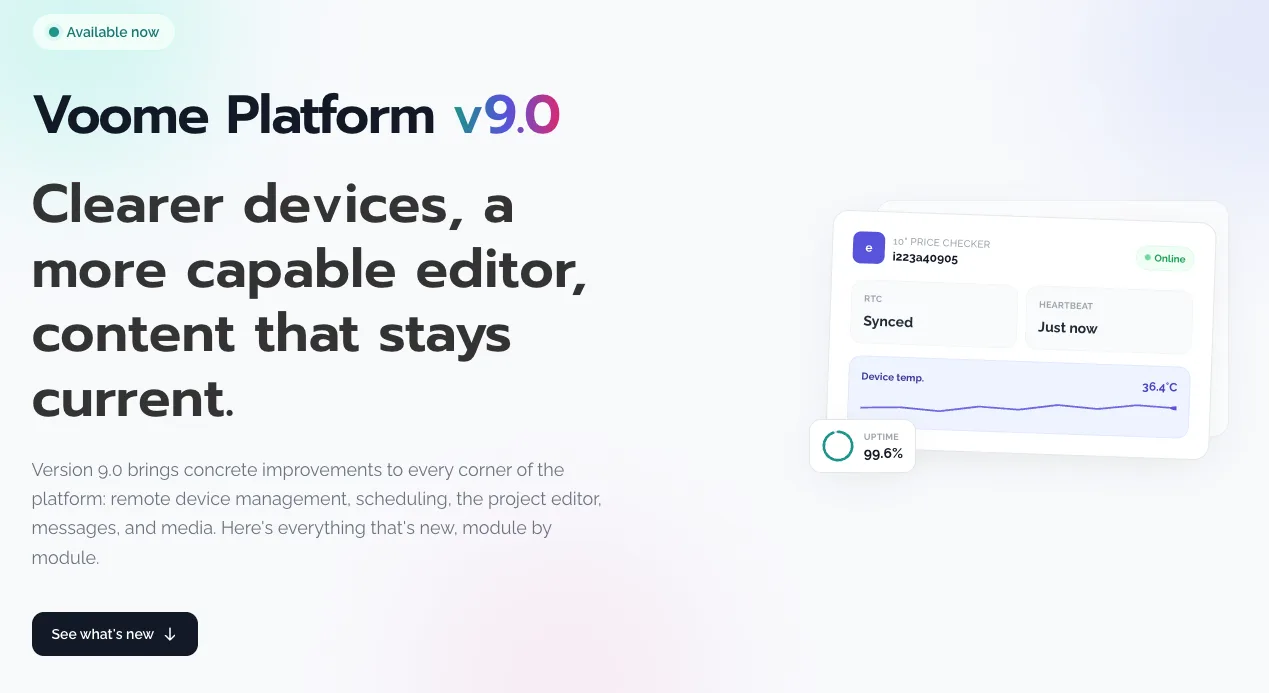
Voome Platform v9.0 | Release Notes Available now Voome Platform v9.0 Clearer devices, a more capable editor, content that stays current. Version 9.0 brings concrete improvements to every corner of the platform: remote device management, scheduling, the project editor, messages, and media. Here’s everything that’s new, module by module. See what’s new e 10″ Price Checker i223a40905 Online RTC Synced Heartbeat Just now Device temp. 36.4°C Uptime 99.6% What’s changing, at a glance Five areas of the platform refreshed in this release. Remote Device Management A richer UI for unmatched device oversight. Scheduling New colors and areas for projects that need extra attention. Project Editor Layers, a grid, built-in upload, and the new Chart Layer. Messages Redesigned section, JSON export, and RSS feeds for categories. Media A fresher UI, drag & drop, and search across the whole platform. 01 · Remote Device Management A device card that tells you everything e 10″ Price Checker i223a40905 RTC OK Status Online Heartbeat Now Firmware 10.29 Lifecycle Activated 01/09Published 02/03 Device Monitor Screen Clock Screenshot on demand With v9.0 Real-time status — serial number, RTC state, online/offline connection, and last heartbeat, always visible at the top of the card. Details and lifecycle — firmware, current IP, expiry, boot mode, and the creation, activation, update, and last-publish dates. Device sensors — device and monitor temperature, screen status, and system clock, all monitorable remotely. Screenshot on demand — a dedicated section to check at a glance what the device is actually showing in the field, when available. In practice Open the card for a kiosk that’s gone offline, and the serial number, last heartbeat, temperature, and monitor status are already there: spotting the problem takes one glance, not a round of phone calls. 02 · Scheduling Colors and areas for projects that need attention Week 24 ‹ › Mon Tue Wed Thu Fri Summer Campaign 32″ Showcase Product Launch — high priority Standard Showcase Needs review With v9.0 New colors and dedicated areas make scheduling easier and more intuitive, immediately highlighting the projects that need the most attention. In practice With three campaigns scheduled at once across different screens, the distinct colors make it easy to spot at a glance which project still needs a review. Project Editor The biggest overhaul in this release The Project Editor is Voome’s creative core. In this version we’ve reworked it in depth: from media upload to layer management, from the new grid to native charts. Project Editor Drop a file here .png .jpg .mp4 .gif Upload Cancel 03 · Built-in upload Upload media without leaving the editor With v9.0 Upload new media directly from the Editor, bypassing the Media module, without breaking your creative flow. In practice Midway through laying out a screen, one image is missing: the designer uploads it on the fly right from the editor and drags it straight into the layout, without losing their train of thought. 120 × 80 px Layers Image Text Widget 04 · Graphic editor Layers that are easier to move and understand With v9.0 Adaptive moving and resizing, with each layer’s micro-details made clearer so you always know exactly what you’re editing. In practice A designer rearranges text, an image, and a weather widget with a few drags, checking each layer’s position and size in real time. Snap to grid 05 · Multi-screen layout A grid for complex layouts With v9.0 The new grid feature guides alignment and composition for complex layouts, including across multi-screen setups. In practice On a project designed for three screens side by side, the grid helps align content precisely along the edges of each panel. Chart Layer North Central South 06 · Data visualization Native charts, right inside the project With v9.0 The new Chart Layer lets you add pie, donut, bar, and line charts, powered by static data or connected to external sources through an API. In practice A storefront display shows sales by region: the pie chart updates itself thanks to the API connection, with no manual work required. 07 · Messages Instant messages, clearer to manage Message categories JSON RSS Opening hours 4 msgs Promotions 12 msgs Security 2 msgs With v9.0 The section has been visually redesigned, with more detail on messages and categories and reorganized fields. Categories now support JSON export and an RSS feed. In practice A category holding the opening hours is also exposed as an RSS feed, ready to be pulled by other company systems. 08 · Media Find and organize media in an instant summer_logo_2026 Used in: Project “Summer Showcase” · Message “Weekend Promo” 1.4 MB1920 × 1080PNG With v9.0 Drag & drop between folders — drag a media file from one folder to another to reorganize your library in a couple of moves. Search across the whole platform — find files even by searching which project or which message uses a given media asset. New preview on thumbnail click — name, size, resolution, and other useful details, without having to open the file. In practice Searching for “summer_logo” also shows which project and which message use that file, so no one accidentally deletes an asset that’s still in use.
Corporate Safety and Geopolitical Crises: Integrating Emergency Triggers with Digital Signage
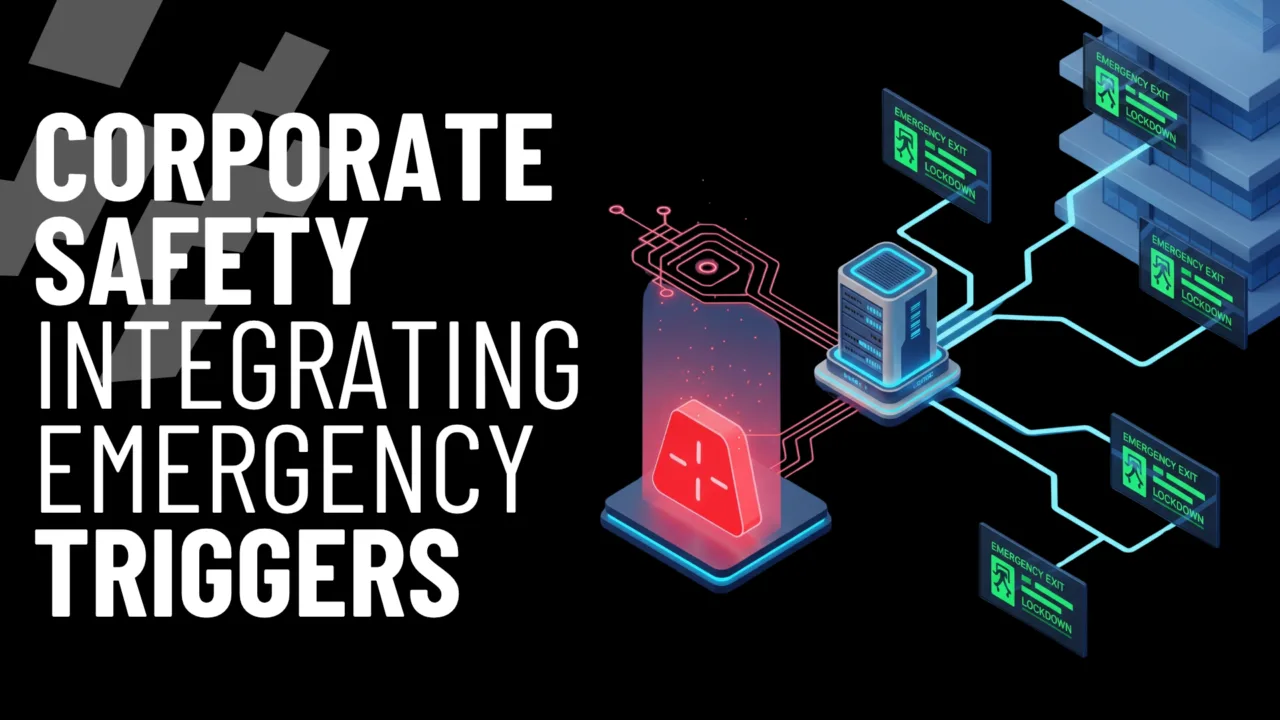
mission critical Corporate Safety and Geopolitical Crises: Integrating Emergency Triggers with Digital Signage In the face of escalating global geopolitical tensions, tech giants are redefining their corporate safety protocols. This article explores why integrating automated emergency triggers within the Voome digital signage network is no longer just an engagement lever, but a mission-critical requirement to protect personnel and manage crises in real time. The corporate sector, particularly the tech industry, is navigating challenges that extend far beyond traditional market dynamics. The response to recent geopolitical crises has demonstrated unprecedented agility, driven by a dual motivation: energy optimization and, above all, personnel safety. Recent events speak volumes: the inclusion of 18 US corporate giants on the “black lists” of sensitive targets by organizations like the IRGC has prompted tech leaders such as NVIDIA, Microsoft, Google, and Apple to immediately activate evacuation protocols or transition to full remote work for offices located in geopolitically unstable or symbolically significant areas. Companies like Amazon (AWS) and Oracle, facing operational disruptions in their Gulf infrastructures, have mandated global agile working for teams not strictly tied to the physical maintenance of data centers. But how do you manage crisis communication in the crucial minutes between a threat’s emergence and the safe evacuation of a headquarters or data center? The answer cannot rely solely on an email or a smartphone notification, which are often overlooked in the daily workflow. This is where Digital Signage evolves from a simple engagement tool into a true life-saving platform. And this is where integrating Voome into your corporate network and connecting it with emergency triggers becomes an irreplaceable strategic asset. The Importance of Automated Emergency Triggers In crisis situations (terrorist alerts, natural disasters, fires, or severe cyber threats), reaction time is everything. Integrating Voome with building security systems means configuring emergency triggers that act fully autonomously. The moment a physical alarm is tripped or a security protocol is activated (e.g., via a panic button or an alert from the building management system), Voome instantly overrides the standard programming of the media repository. Every display connected to the corporate network converts into an emergency hub, projecting clear, visible, and unambiguous escape routes, lockdown instructions, or evacuation directives—bypassing any human latency. Cluster Distribution: The Right Message, Only Where Needed Multinationals like Google or AWS operate on a global scale. An alarm in the Gulf should not trigger panic or operational disruptions in the London or Milan offices. Thanks to Voome’s advanced scheduling capabilities, the deployment of emergency content can be highly segmented. The system allows distribution to be divided into clusters, differentiating alarm policies by geographic area, specific buildings, or even individual floors. From the central CMS, the security team can manage and monitor devices remotely, ensuring that the evacuation protocol is activated exclusively at the at-risk sites. Security & Compliance: Why ISO 27001 Makes the Difference When dealing with critical infrastructures and companies targeted by government entities or state-sponsored hackers, network security allows for no compromises. Many basic digital signage platforms rely on simple, unprotected web links to display data, creating dangerous vulnerabilities within the corporate network. Voome is an enterprise-grade, all-in-one platform, certified ISO 27001. This means that native integration with ecosystems like Microsoft 365, Google Workspace, Qlik, and corporate directories occurs within a perimeter of maximum security. A malicious actor cannot hack the displays to broadcast false alarms or incite panic, because Voome’s architecture guarantees rigorous cryptographic and access management standards, protecting both the CMS editor and the remote control of the devices. Conclusion The responsiveness demonstrated by tech leaders in the face of recent geopolitical tensions sets a new standard for corporate resilience. Transforming physical spaces into responsive, intelligent environments is no longer a “nice to have,” but a strict necessity for compliance and social responsibility. Integrating Voome means equipping yourself with an advanced digital signage ecosystem that, when necessary, transforms into the central nervous system of corporate security. Because when the safety of your people and the protection of critical assets are on the line, visual communication must be instantaneous, targeted, and, above all, unassailable. You choose us for Reliability Safety Assistance Book to demo
Digital Signage 2026: It’s Not About Screens, It’s About IT Governance
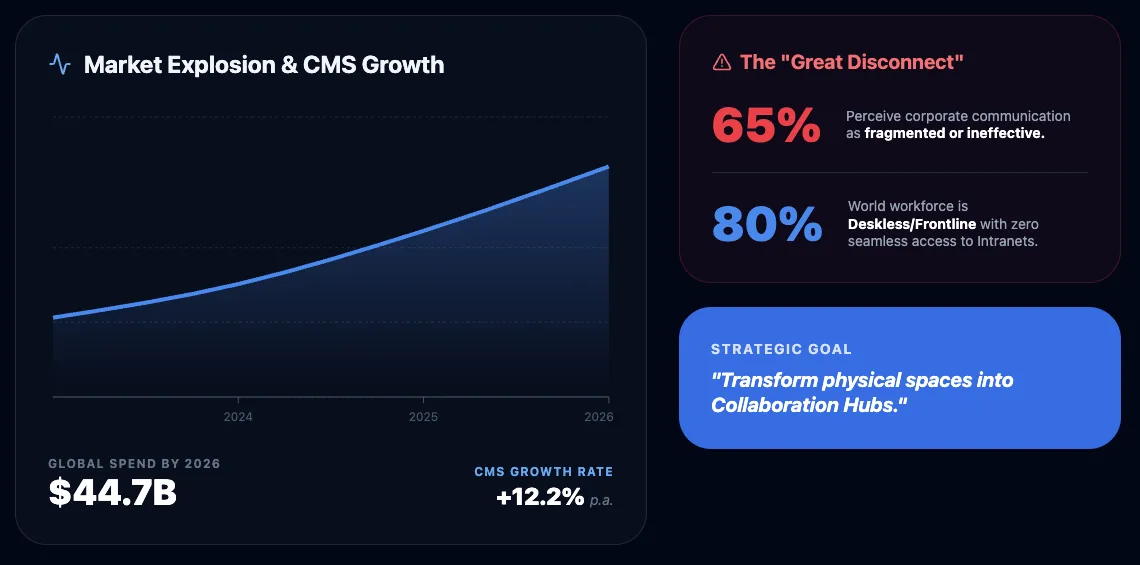
Mercato Digital Signage 2026: It’s Not About Screens, It’s About IT Governance The 2026 corporate landscape marks the definitive end of the ‘dumb screen’ era. With 80% of the global workforce now classified as deskless and the Digital Signage market surging toward $44.7 billion, internal communication has shifted from a marketing ‘nice-to-have’ to a mission-critical IT Governance priority. In the 2026 corporate landscape, internal comms is no longer a “nice-to-have.” It’s a systemic challenge. Companies are fighting to bridge the gap with a hybrid, distributed, and deskless workforce that’s more disconnected than ever. Traditional channels are failing. Enter Enterprise Digital Signage: no longer just a passive display, but a mission-critical infrastructure for IT Governance. If ISE 2026 proved one thing, it’s that the era of the “dumb screen” in the breakroom is dead. We are seeing a massive disruption. Blue-chip manufacturers and financial giants aren’t asking how to “show slides” anymore. They’re asking how to solve a systemic employee engagement crisis. For IT and AV pros, selling a Digital Signage solution today means selling critical infrastructure. You need the data, the vision, and the enterprise-grade muscle to back it up. The “Great Disconnect”: Your ROI Case Study Let’s talk numbers. Right now, 65% of the global workforce finds corporate communication fragmented. For the 80% of workers who are deskless—the frontline heroes in retail and logistics—there is no “seamless” access to email or Slack. This isn’t just a communication gap; it’s an operational risk. The market sees the fire: global Digital Signage spend is projected to hit $44.7B by year-end 2026, with CMS software seeing double-digit growth. The mission? Turn physical spaces into high-octane collaboration hubs. From Content Distribution to “Spatial Intelligence” The game has changed from “pushing pixels” to Spatial Intelligence. Screens are now Decision Surfaces. In the hybrid office, your team needs real-time desk booking, meeting room availability, and deep integration with Microsoft Places. On the factory floor, they need real-time KPI dashboards and instant safety alerts. This requires complex orchestration. This is where the “cheap” solutions fall apart. The “Integration Debt” Trap Entry-level vendors (think Yodeck or OptiSigns) love to play the volume game. But when you put those platforms in front of a CIO or CISO, the project hits a wall. The biggest red flag? Public web links. Low-cost platforms “cheat” by pulling data via exposed URLs. No serious Enterprise is going to broadcast their PowerBI or Qlik data through unencrypted links that bypass the firewall. That’s not a solution; it’s a security breach waiting to happen. Why Voome is the New Gold Standard To win the big-ticket Enterprise contracts, you need a platform built for extreme governance. This is where Voome changes the game: Security-First DNA: ISO 27001 isn’t just a badge; it’s a requirement. We’re talking SSO, MFA, and granular RBAC. If it doesn’t pass a brutal IT audit, it doesn’t belong on your network. Native API Power: No more public links. Voome talks directly to Microsoft 365, Google Workspace, and Qlik via secure API tunnels. Data stays locked down, period. The “Logic Edge”: Downtime is a deal-breaker. Voome’s hybrid architecture caches content locally. If the network drops, the show goes on. Total MDM Control: A real CMS is an MDM in disguise. Manage everything from touch-interactive projects to hardware updates across LG, Samsung, Android, and Windows from one single pane of glass. The Bottom Line: Stop Selling Hardware. Start Selling Governance. In 2026, Digital Signage isn’t a marketing expense it’s an infra-asset. It’s the glue between HR, IT, and Operations. Your job isn’t to find the brightest screen; it’s to deploy the most secure, intelligent “brain” in the building. You choose us for Reliability Safety Assistance BOOK A DEMO Digital Signage 2026: It’s Not About Screens,It’s About IT GovernanceMarch 2, 2026Mercato Digital Signage 2026: It’s Not About Screens, It’s About…Read MoreVoome vs. Navori: Choosing the Right Enterprise Digital Signage PlatformFebruary 24, 2026Comparison Voome vs. Navori: Choosing the Right DIGITAL SIGNAGE PLATFORM…Read MoreBeyond Digital Signage: How Voome is Powering the Olympic Spirit at Milan MalpensaFebruary 12, 2026Beyond Digital Signage How Voome is Powering the Olympic Spirit…Read More
Boost Your Digital Signage with Native Google Workspace Integration via Voome

Ottimizza i processi interni Boost Your Digital Signage with Native Google Workspace Integration The Challenge: Automating Google Workspace Updates Connect your digital signage to Google Drive, Docs, Sheets, Slides and Calendar through Voome’s native API integration. Automate content updates, ensure data accuracy, and streamline your communication—without the hassle of public links. Why Integrate Google Workspace into Digital Signage? In the age of smart collaboration, every corporate touchpoint—including display screens—can become a dynamic asset. That’s why integrating digital signage with Google Workspace is becoming essential for businesses, schools, and organizations. The goal? Optimize content management, improve operational efficiency, and ensure communication is always up-to-date. Google Workspace Meets Digital Signage: A Connected Ecosystem With Voome’s integration, post content dynamically using your everyday tools: Google Drive Google Docs Google Sheets Google Slides Google Calendar Any update made in these apps instantly reflects on your digital signage screens no manual steps required. Voome: The Only Platform with Native API Integration Most digital signage solutions rely on public links. Voome, however, connects directly via API using your Google Workspace account, delivering: Enhanced security: No public links, permissions controlled by Google Real automation: Content updates automatically Operational efficiency: Fewer errors, more time saved Seamless user experience: Change a file, see it live How Each Google Tool Powers Your Signage Google Drive Link folders or files from Drive to Voome to maintain centralized control and real-time updates. Google Docs Display HR memos, internal notices, or procedural documents without manual refreshes. Google Sheets Show KPIs, sales data, or project dashboards live and up-to-date. Google Slides Create visual presentations for promotions, onboarding, or internal loops—live and synced. Google Calendar Display events, room bookings, or staff schedules filtered by team or location automatically. Why Voome + Google Workspace Is a Winning Combo Voome Other Systems ✅ Native integration via API ❌ Require open links 🔄 Automatic updates 🔁 Manual updates 🔐 Higher security ⚠️ External sharing required ⚙️ Lower operational effort ⏳ Repetitive and unscalable tasks https://voome.com/wp-content/uploads/2025/07/Video-google-workspace.mp4 🔹 How do I connect Google Workspace to the Voome platform? Through native API integration: simply authenticate your company’s Google account, select the documents, and assign them to your layouts. 🔹 Can I use Google Sheets to display live data? Absolutely. Any updates made in Sheets are automatically synced to your screens. 🔹 Why is native integration better than using a public link? Because it’s more secure, more stable, and more efficient. There’s no need to manually update links or permissions. 🔹 Do I have to manually update the content? No. Everything is automatic. Once the files are integrated, any change is reflected on the digital signage in real time. Ci scegli per l'Affidabilità la Sicurezza l'Assistenza Prenota una demo Boost Your Digital Signage with Native Google Workspace Integration via Voome July 11, 2025Ottimizza i processi interni Boost Your Digital Signage with Native…Read More The Digital Signage Market: A Golden Opportunity for Distributors and Resellers in the UK and Beyond June 17, 2025Voome News The Digital Signage Market: A Golden Opportunity for…Read More Voome Gets a Makeover: version 8.0 is LIVE! April 17, 2025Voome News Voome Gets a Makeover: version 8.0 is LIVE!…Read More